The importance of .NET 5
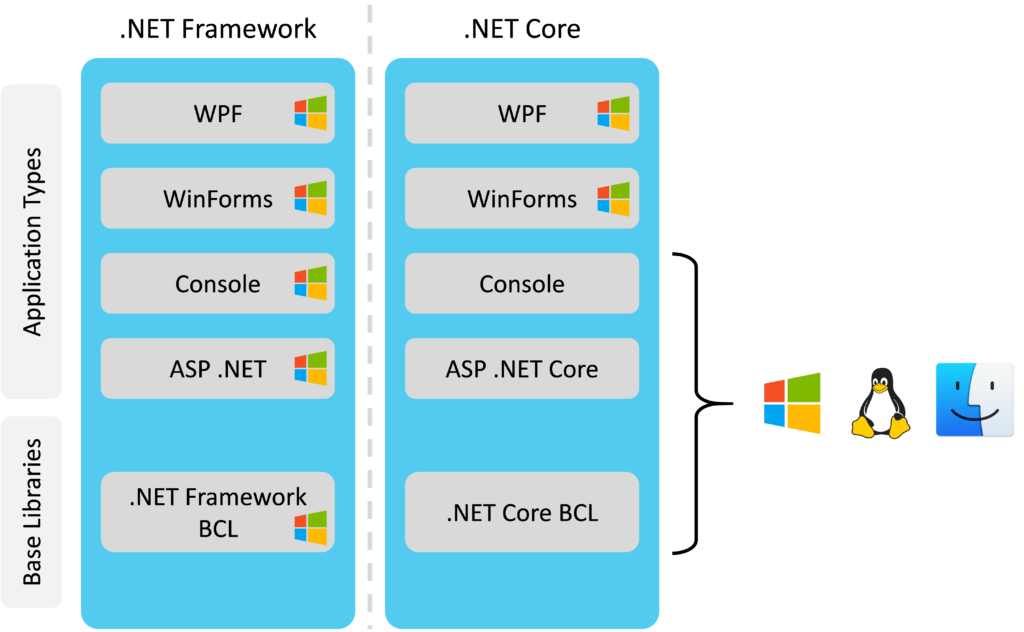
.NET 5 represented the culmination of Microsoft's multi-year effort to unify the .NET ecosystem. Before .NET 5, the landscape was split between the legacy .NET Framework (Windows-only, mature but stagnant), .NET Core (cross-platform, modern, but missing many Framework APIs), and Xamarin (mobile). .NET 5 merged these into a single runtime and SDK, establishing the path forward for all .NET development. For industrial computer vision teams using C# for their application layer, this unification removed a significant source of friction.
The most immediate practical benefit for computer vision applications is true cross-platform consistency. Machine vision software built on .NET 5 runs without modification on Windows, Linux (x64 and ARM64), and macOS. This is particularly valuable for teams that develop on Windows workstations but deploy to Linux-based industrial PCs or embedded systems. Libraries like Emgu CV (the .NET wrapper for OpenCV) gained improved Linux and ARM support with the .NET 5 transition, reducing the sharp edges that previously made cross-platform deployment with Emgu unreliable.
Performance improvements in .NET 5 are meaningful for image processing workloads. The JIT compiler gained new loop optimizations and SIMD intrinsics support via System.Runtime.Intrinsics, enabling developers to write vectorized image processing code that approaches native C++ performance. For algorithms like custom convolutions, histogram computation, or pixel format conversion that aren't covered by hardware-accelerated OpenCV operations, these SIMD APIs provide a viable high-performance alternative without leaving managed code.
The unified platform also simplifies interoperability with native vision libraries. P/Invoke in .NET 5 gained improved marshalling performance and better handling of complex native types. For teams integrating with camera SDK DLLs (Basler pylon, FLIR Spinnaker, Cognex VisionPro), the more consistent P/Invoke behavior across platforms reduced the fragile per-platform marshalling workarounds that were common in .NET Core 3.x projects.
Looking forward from the .NET 5 baseline, the subsequent releases (.NET 6, 7, 8) built on this foundation with LTS stabilization, NativeAOT compilation (enabling truly standalone binaries with no runtime dependency), and further JIT improvements. For computer vision applications requiring deterministic startup times or tight deployment packaging, NativeAOT in .NET 7+ is a compelling capability that traces directly to the architectural work done in .NET 5.